.png?width=275&height=77&name=HETT%20insights%20logo%20RGB-01%20(2).png "HETT insights logo RGB-01 (2)")
Healthcare organisations are undergoing a major digital transformation. While information security teams have strengthened human-centric defences using Multi-Factor Authentication (MFA), NHS smartcards, and conditional access, the systems increasingly driving healthcare delivery are machine-driven. As organisations embrace automation, APIs, cloud-native systems, and AI, non-human identities—including service principals, managed identities, applications, and bots—are expanding rapidly. This shift is particularly evident in enterprise automation and Robotic Process Automation (RPA) environments.
For solution architects, legacy authentication for unattended automations remains a severe bottleneck. The dominant automation pattern relies on dedicated service accounts with traditional, long-lived credentials. This model imposes significant operational burdens. In healthcare, an uncoordinated credential rotation can disrupt patient administration, diagnostics, or discharge workflows.
Recent platform capabilities such as Power Automate Credential Manager improve credential storage, access control, and environment variable orchestration. Importantly, Credential Manager governs secrets, while modern non-human identities provide the identity foundation for enterprise automation. These are not competing technologies, but complementary pillars. By shifting from standalone credential vaulting to workload identities, enterprises can significantly reduce reliance on traditional credentials through modern workload identity models and Certificate-Based Authentication backed by non-human identities. As healthcare automation and clinical AI evolve, non-human identity governance is becoming foundational to resilient digital healthcare delivery.
Why Credential Management Alone Is No Longer Enough
Unattended workflows process data, query databases, and access legacy desktop applications without human intervention. Configuring these processes with traditional user credentials exposes the enterprise to three critical risk vectors:
-
The Rotation Dilemma: Governance policies require password rotation every 30 to 90 days. For an automation portfolio with hundreds of active workflows, updating these credentials requires manual coordination. A minor rotation misalignment can cause critical background flows to fail. In healthcare, this may interrupt automated transfers between patient administration systems, pathology platforms, and Electronic Patient Record (EPR) integrations.
-
Credential Vault Boundaries: Vaults mitigate embedded password exposure but do not eliminate lifecycle tracking requirements. Organisations must protect vault entry points and rotate secret keys. While role-based access controls (RBAC) and privileged access management within vaults limit exposure, a compromise of highly privileged service tokens can still expose critical downstream entry points.
-
Interactive Bypass Risks: Legacy service accounts often require interactive login privileges to initialise local desktop environments. Because these accounts operate outside normal user sign-in patterns, they can be subject to weaker policy enforcement and become attractive targets for misuse, increasing the risk of lateral movement if compromised.
An Identity-First Architecture for Machine Workloads
A resilient, Microsoft-centric design enables passwordless authentication across supported orchestration layers by utilising a unified Service Principal paired with infrastructure-level controls.
| Automation Layer | Modern Authentication Model | Technical & Security Mechanism |
| Cloud & Desktop Automation | Dataverse Application User | Provides a trusted workload identity within Dataverse that securely retrieves secrets from Azure Key Vault, reducing dependency on separately managed application identities and simplifying identity bootstrap. |
|
Desktop Flow Bridge |
Power Automate Credential Manager | Centrally manages credentials, X.509 certificates, and environment variable references used by desktop automation, reducing reliance on manually managed secrets. |
| Host Virtual Machines | Group Managed Service Accounts (gMSA) | Establishes managed service identities for host runtimes and supporting gateway services, eliminating manual password management through Active Directory–managed credential rotation. |
Figure 1 illustrates the trust relationships underpinning an identity-first automation architecture.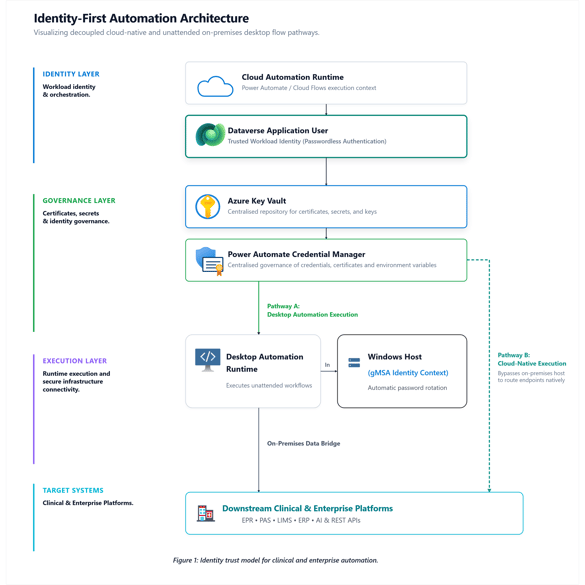
-
Unified Flow Execution
At the orchestration layer, configuring a Dataverse Application User shifts the security paradigm from traditional interactive user authentication to an isolated workload identity context. Rather than hardcoding access keys or maintaining separate Microsoft Entra App Registrations, this architecture binds environment variables directly to Azure Key Vault. The platform securely resolves execution requests, streaming operational secrets in real time to support cloud flows, desktop flows, Windows logons, and cross-application connectors—including healthcare integrations where unattended processes coordinate data between cloud services and clinical applications. This native environment integration simplifies identity bootstrapping while significantly reducing the administrative burden of tracking, securing, and rotating standalone application credentials.
-
Securing the Cloud-to-Desktop Connection Bridge
The most difficult challenge in automation security is the "last mile" - establishing trust between the cloud orchestration layer and the target machine environment. The Power Automate Credential Manager mitigates this boundary risk by replacing manually managed authentication parameters with native platform-managed configurations. Using registered runtime clients backed by managed X.509 certificates, enterprise architectures can cleanly provision, monitor, and revoke unattended execution queues. This centralised architecture allows the system to establish a trusted cloud-to-desktop handshake without exposing plain-text platform credentials or local gateway passwords.
- Hardening the Local Virtual Machine Runtime
Once the connection signal reaches the target virtual machine, the local operating system must execute runtime processes securely. In Windows infrastructure, organisations can deploy Group Managed Service Accounts (gMSAs) to run supporting infrastructure services like On-Premises Data Gateways or local host administrative accounts. Active Directory automatically manages and rotates complex passwords on behalf of the account. The unattended automation host benefits from this secure context, significantly reducing reliance on manual service account passwords.
While this architecture removes static strings from the core platform, downstream legacy applications like EPR portals or an Electronic Document Management (EDM) system may still require separate credentials, making hybrid strategies that combine workload identities with centralised credential vaulting vital.
-
The Broader Impact: Governance Beyond RPA in Clinical AI Ecosystems
The necessity of non-human identity management extends far beyond unattended desktop flows. Service principals, managed identities, API integrations, and emerging AI tools all require machine identities to access data resources securely. Traditional automation followed predictable code pathways, but modern agentic AI systems analyse data and interact with enterprise APIs autonomously.
Healthcare providers are rapidly adopting AI-enabled services including ambient clinical documentation, intelligent triage, operational copilots, and predictive analytics. Every clinical AI solution ultimately operates through machine identities, whether accessing patient records, retrieving clinical context, or interacting with enterprise APIs. As these autonomous workloads increase, digital identity governance becomes a prerequisite for safely scaling digital health services rather than simply a security consideration.
If an autonomous workload or AI agent is granted excessive permissions, the impact of a compromise can increase significantly. Solutions architects must enforce isolated boundary zones and apply strict lifecycle governance to non-human identities.
Beyond cybersecurity, identity-first automation strengthens governance by improving traceability, reducing operational risk, and supporting alignment with NHS Data Security and Protection Toolkit (DSPT), DCB0129, and DCB0160 principles.
Conclusion
Credential Manager simplifies how organisations manage secrets today, but the long-term evolution of enterprise and healthcare automation lies in identity-first architectures where non-human identities, governed through Microsoft Entra ID and Zero Trust principles, form the foundation of secure digital services. Relying on human-centric credentials for machine execution introduces unnecessary risk and administrative overhead.
The future of automation will be defined by how effectively organisations govern machine identities rather than how well they rotate passwords. Treating non-human identities as first-class security principals enables organisations to scale automation while supporting long-term Zero Trust goals.
Author Biography
Henry Obison is a Chartered Engineer (CEng), a Leading Practitioner of the Federation for Informatics Professionals in Health and Social Care (LFEDIP), a Fellow of the British Computer Society (FBCS), and a BCS Fellowship Assessor. He holds Microsoft certifications as a Power Platform Solution Architect and Power Automate RPA Developer, alongside an MSc in Information Systems.
%20(1).png?width=275&height=77&name=HETT%20insights%20logo%20RGB-04%20(1)%20(1).png "HETT insights logo RGB-04 (1) (1)")